The Royal Society for the Protection of Birds is one of the UK’s most recognisable conservation organisations, managing over 200 nature reserves across the country and operating a fleet of approximately 350 vehicles. Committed to being a nature-positive organisation and moving towards a net climate cooling impact, the RSPB has had a formal greening programme in place since the 1990s – and fleet electrification is a key part of that ongoing journey.
But electrifying a fleet of this scale and geographic diversity is far from straightforward. Many RSPB reserves are located in remote, rural settings with limited access to public charging infrastructure, while the nature of the sites themselves – narrow paths, protected habitats, sensitive ecosystems – demands vehicles that are as practical as they are sustainable.
It is against this backdrop that two micro electric utility vehicles (MEV) have quietly found their place at two of the RSPB’s most celebrated sites: its UK headquarters at Sandy in Bedfordshire, and the iconic Sherwood Forest Nature Reserve in Nottinghamshire.
The Challenge: A Diesel Van That Was Costing More Than It Was Worth
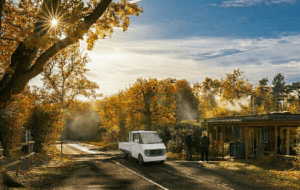
The story at Sherwood Forest begins with a problem familiar to many fleet operators: a diesel van being used in a way it was never designed for. The vehicle was deployed exclusively on-site, covering only short distances on a daily basis, but the engine was never getting warm enough to function properly.
“The injectors were constantly getting blocked,” explains Tim Twiss, Fleet Manager at the RSPB. “The Diesel Particulate Filters couldn’t regenerate because of the short distances, and in the end it affected the whole fuel system. It was causing serious problems.”
The solution, Twiss decided, was not another diesel vehicle – and not a conventional electric van either. The narrow paths and lanes running through the reserve ruled out anything too large. What was needed was a micro electric vehicle: compact enough to access every part of the site, but capable enough for the physical and practical demands of daily operations.
The Purchase: The Right Vehicle for the Right Site
After researching the available options, Twiss selected a Derry Neomor D01 micro electric van from JLC EV – distributed exclusively in the UK by JLC EV– as the best value solution for the RSPB’s needs. A single-seater model, it has since been re-deployed to the RSPB’s Sandy headquarters, where it has been put to good use by the site gardener to transport mowers, tools, and equipment across what is a sizeable rural estate with an adjoining nature reserve.
At Sherwood Forest, a two-seater MEV was sourced, fitted by JLC EV with a tipper bed and a cage on the back – a specification shaped directly by the site team’s day-to-day requirements.
On the Ground at Sherwood Forest
Trish Storey, Facilities Manager at Sherwood Forest, is candid about what matters most. “Because Sherwood Forest is a Site of Special Scientific Interest, the most important thing for us was to have a van that was eco-friendly and kind to the environment. But as well as having zero emissions, it also needed to be fit for purpose,” she explained.
“Despite the micro electric vehicle’s compact size, it still ticks all the boxes for everything we need it to do. This reserve is a major tourist attraction that hosts big events and gets a lot of visitors in the summer months, so we use the van for everything from site maintenance to transporting larger equipment like tents, marquees and stages.”
As a Site of Special Scientific Interest, Sherwood Forest is home to ancient oak trees, rare wildlife, and the legendary Major Oak. It is precisely this protected status that makes zero-emission transport so important on site.
The vehicle’s tipper functionality has also proved particularly valuable. With a hydraulic bed that tilts to allow materials to be slid on and off rather than manually lifted, it has made a real difference to how the team handles equipment – particularly during the busy summer events season when the reserve hosts large public gatherings.
The Broader Fleet Picture
For Twiss, the MEVs at Sandy and Sherwood Forest represent a microcosm of the wider challenge he faces managing a diverse national fleet.
“Because of the RSPB’s charitable status and the unique nature of its reserves, I have to look at different kinds of mobility solutions that are suitable for each one. We are committed to being more sustainable and reducing our greenhouse gas emissions, so I will try to purchase electric vehicles for our fleet wherever it is practical,” he revealed.
“For these two sites, micro electric vehicles are perfect. Compared to the diesel vans they replaced, they are more efficient and reliable for the shorter journeys they are used for, save a lot in maintenance costs, and their compact size offers exactly the kind of accessibility we need for the narrower roads, lanes and pathways you find at our nature reserves.”
The RSPB’s commitment to reducing its environmental footprint – enshrined in its formal Environmental Policy and tracked through its annual greenhouse gas reporting – makes fleet electrification a strategic as well as operational priority. But as Twiss explains, the pace of transition is slow but steady: remote sites require investment in dedicated charging infrastructure, and switching a fleet of 350 vehicles cannot happen overnight.
Where it can happen, it does. And at Sandy and Sherwood Forest, two micro electric vehicles are proving that when the vehicle is right for the role, the benefits go well beyond the environmental.