As an electric vehicle specialist focused exclusively on last-mile delivery and urban fleet operations, JLC EV has identified a worrying trend: businesses running moped fleets are making do with vehicles built for everyday commuters, not the demands of daily commercial duty. That’s why it is bringing the Benzina Zero Duo range – electric mopeds designed with exactly those demands in mind – to the UK.
The range is central to JLC EV’s mission to give UK businesses the right electric vehicle for the hardest-working parts of their operations. Designed in Australia and now available to UK fleets for the first time, the Benzina Zero Duo and Duo+ represent a fundamentally different philosophy to the scooters most delivery businesses currently rely on. To understand why, it helps to look under the panels – or in the Duo’s case, to notice there aren’t many panels to look under at all.

A Frame Designed for Work, Not Just the Road
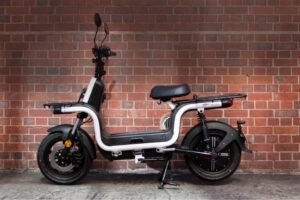
The most striking difference between the Benzina Zero Duo and a conventional scooter – think Honda, Piaggio, or similar – begins with the frame itself. Where most scooters use a single central spine made from stamped and pressed sheet steel, the Duo uses a twin tubular steel frame with a boxed mid-section and multiple welded reinforcement gussets. This double-spine architecture is not just a design choice; it is a structural statement.
The continuous tube bends distribute load more evenly across the frame, resulting in a higher stiffness-to-weight ratio than a conventional pressed-steel equivalent. In plain terms: the Duo is stiffer, lighter, and stronger – exactly the combination you want when a vehicle is being ridden hard, day after day, with cargo on board.
Built to Last in British Conditions
Corrosion resistance might not be the most glamorous selling point, but for any business running a commercial fleet on UK roads – where rain, road salt, and grime are a daily reality – it matters enormously. The Duo is finished using an electrophoretic dip-coat process (similar to the method used in the automotive industry), which delivers a smooth, even, protective layer across the entire frame, including hard-to-reach joints and welds.
Conventional scooters, by contrast, are typically coated with a basic factory primer beneath their body panels. This does the job when new, but with age and exposure, those hidden areas become vulnerable. On a fleet vehicle covering high mileage, that difference in durability can translate directly into higher maintenance costs and shorter service life.
Designed to Be Modified – and Maintained
One of the Duo’s most commercially valuable features is one that rarely makes marketing headlines: its integrated mounting system. The dual-spine frame incorporates purpose-built brackets, rails, cutouts, and gussets that allow accessories and cargo fitments – such as boxes, racks, and frames – to be attached directly to the structural frame itself, not bolted to fragile body panels as is often the case with conventional scooters.
This matters for two reasons. First, it means the Duo can handle real commercial payloads without risk of the kind of panel flex or fitment failure that plagues conventionally framed machines used for delivery work. Second, it makes the vehicle significantly faster and easier to service – technicians can access components more directly, and modular accessories can be swapped without major disassembly.
Lighter, More Agile, and Better in Traffic
The Duo’s lighter frame has a direct and noticeable effect on how the vehicle handles, particularly at the low speeds that characterise urban delivery work. Its 1,210 mm wheelbase sits at the shorter end of the spectrum compared to conventional scooters, which can range up to 1,400 mm or beyond. That shorter wheelbase, combined with a lower centre of gravity achieved by mounting the battery beneath the footwell, translates into sharper turning, more responsive handling, and greater ease when filtering through congested streets.
A longer wheelbase can offer stability advantages at motorway speeds, but at the urban velocities where delivery mopeds spend the vast majority of their working lives, it adds weight and reduces agility without delivering meaningful benefit. The Duo is optimised for the environment it actually operates in.
The Bigger Picture: Why This Matters for UK Businesses
The Benzina Zero Duo is not trying to be all things to all riders. It is a purpose-engineered commercial vehicle, and every design decision reflects that. For a UK delivery company or fleet operator evaluating their options, the case is straightforward: a lighter, stiffer, more corrosion-resistant, and more modular frame means lower running costs, fewer breakdowns, easier maintenance, and longer vehicle life. Those are not abstract engineering advantages – they show up directly on the bottom line.
For more information or to arrange a demonstration, visit www.jlcev.com, email sales@jlcev.com, or call 0330 0532 030.