Talk to any logistics manager who runs urban delivery operations and you’ll hear the same frustration, expressed in different ways. The cargo bike is brilliant, until the load is too heavy or the weather too hostile. The moped covers ground quicker, but suffer the same limits. And the Transit? It gets the job done, eventually – once your driver has spent twenty minutes hunting for somewhere to park, nudged a wing mirror in a pinch point, and burned through enough diesel idling in traffic to make your emissions figures wince.
This is the gap. And for years, it’s been quietly costing the UK delivery sector in wasted time, operational inefficiency, and vehicles that simply aren’t the right tool for the job. For years, the gap has left parcel carriers, pharmaceutical distributors, food delivery fleets and more chronically underserved.
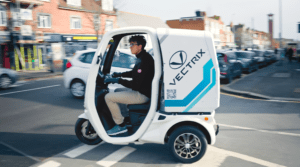
JLC EV, the Sussex-based electric vehicle specialist, has found the answer: the Vectrix i-Cargo, a three-wheel electric utility vehicle that has been quietly redefining last-mile delivery across Asia, and is now available in the UK.
The Delivery Problem Nobody Talks About
E-commerce has fundamentally changed the delivery challenge. Volumes are up, time windows tighter, urban density higher, and consumer expectations – for speed, flexibility, and sustainability – have never been more demanding. At the same time, Clean Air Zones are expanding across UK cities, and pressure on fleet operators to decarbonise is intensifying from all directions: regulation, procurement requirements, ESG commitments, and rising fuel costs.
Most fleet managers have responded by investing in either end of the spectrum. Electric cargo bikes for hyperlocal, lightweight deliveries. Electric vans for higher-volume, longer-route work. But the middle – smaller volumes, restricted access areas, congested inner-city streets, time-sensitive deliveries that don’t justify a full van but are too demanding for a cargo bike – remained a stubborn operational puzzle. Enter: the i-Cargo.
What the i-Cargo Actually Is
Let’s be precise. The Vectrix i-Cargo is a three-wheel electric utility vehicle with a full weatherproof roof, single-seat cockpit, and a substantial rear cargo compartment. Think of it as the vehicle class that should have existed long before now.
With up to 93 miles of range on three battery packs, the i-Cargo can last a full commercial shift without mid-route charging anxiety. Its also boasts a 235 kg payload capacity – enough for a commercial load of parcels, groceries, pharmaceuticals, or chilled goods – while a 52 mph top speed means it is capable on A-roads, not just urban streets.
A 3-metre turning circle makes the i-Cargo genuinely transformative in congested streets and loading zones, and its Swappable batteries can be charged in under 3.5 hours or hot-swapped at depot for zero operational downtime.
The swappable battery system deserves particular attention from fleet managers focused on operational efficiency. Hot-swapping batteries at a depot – rather than waiting for a vehicle to charge – means a single i-Cargo can, in principle, run consecutive shifts without downtime. For operators running time-sensitive delivery windows, that’s a meaningful productivity advantage.

The Urban Advantage
Here’s where the i-Cargo’s form factor becomes genuinely compelling for fleet planning. British cities are not getting less congested. High streets are not getting wider. And the expectation that a delivery driver can pull up outside a specific shop, make a drop, and be on their way inside three minutes is not going away.
At 2,130mm long and 1,020mm wide, the i-Cargo can access loading zones, side streets, and delivery bays that are routinely blocked or inaccessible to a Transit or similar. A rear camera, LCD instrument panel, hydraulic rear suspension, and front wipers complete an all-weather cockpit that takes the vehicle well beyond the category of glorified scooter.
Built for the Real Demands of Fleet Operation
What distinguishes the i-Cargo from previous attempts to address this vehicle category is its genuine commercial specification. The rear cargo box is configurable with refrigerated or heated units – a capability that opens the door for Quick Service Restaurant fleets, meal kit operators, pharmaceutical distributors, and healthcare supply chains to operate in a way that simply isn’t feasible with a cargo bike or moped.
One of the perennial challenges in last-mile fleet recruitment is the licensing barrier to mopeds and motorcycles. The i-Cargo’s L5e classification, combined with its tilt-free three-wheel chassis, means any driver with a full Category B car licence – and aged 21 or over – can operate it. That’s the vast majority of the UK adult driving population.
Part of a Broader Electric Fleet Ecosystem
JLC EV positions the i-Cargo as the anchor of a complete micro electric fleet ecosystem. Alongside the Benzina Zero Duo e-scooter and HAULeR e-cargo bike range, and the Derry Neomor D01 micro electric van, the i-Cargo allows fleet managers to match the right vehicle to every delivery scenario – from a single e-cargo bike for a small independent retailer to a mixed multi-model fleet for a national logistics operator.
This ecosystem approach matters because the delivery gap isn’t one-size-fits-all. A pharmaceutical distributor making multiple drops to GP surgeries across a mid-sized city has different needs to a food delivery operator servicing a dense inner-city postcode. What they share is the requirement for a vehicle that’s more capable than a bike but more nimble than a van – and for both, the i-Cargo is likely the most commercially logical answer currently available in the UK.