Ask any fleet manager who has looked at electrifying a last-mile delivery operation and you’ll hear the same hesitation. The vehicles are getting better. The running costs are compelling. Clean Air Zone pressures are real. But the charging time? That is where barriers can start to go up.
A petrol moped or a diesel van can be refuelled in minutes and be back on the road. A conventional electric vehicle, plugged into even a reasonably fast charger, needs a few hours. For a fleet running consecutive delivery shifts, that is not a minor inconvenience.
It’s a problem that JLC EV, has placed at the centre of its fleet proposition. The answer, built into three of its core vehicles, is elegantly simple: don’t wait for the battery to charge. Swap it out. Have a fully charged one ready. Keep moving.
The Swap in Practice
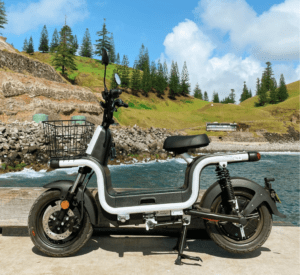
The principle is straightforward, but its commercial implications are significant. A delivery rider on a Benzina Zero Duo or Duo+ electric moped returns to their depot or collection point at the end of a delivery run. The battery is removed in seconds. A fully charged replacement battery goes straight in. The rider is back on the road in under two minutes. There is no need to plug in, no charge status to monitor, no queue for a charging bay.
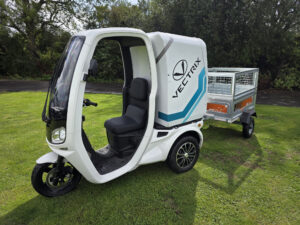
The same logic applies at larger scale with the Vectrix i-Cargo. JLC EV’s three-wheel electric utility vehicle also supports battery swapping. With the ability to run up to 93 miles on three battery packs, the i-Cargo is already capable of a full commercial shift on a single load. For operations running back-to-back shifts or particularly high-mileage routes, hot-swapping batteries at the depot means the vehicle can run consecutively without any charging downtime at all.
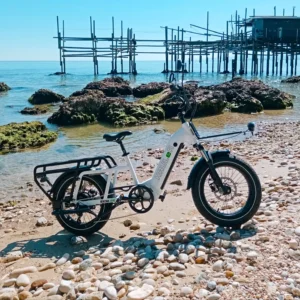
The Benzina Zero HAULeR e-cargo bike – which carries a 155 kg payload on no licence whatsoever, making it accessible to a broad pool of delivery riders – takes the same approach. Its 48V 20Ah lithium battery is fully removable and can be taken to any standard wall socket to charge, or swapped for a pre-charged spare and redeployed immediately.
The operational benefits land differently depending on your delivery model. But across three of the highest-demand sectors in UK last-mile logistics, the swappable battery advantage is consistently compelling.
Parcel and Package Delivery
Parcel carriers are among the most time-pressured operators in the industry. Delivery windows are tight, collection frequencies are high, and driver productivity is measured in stops per hour.
With a Benzina Zero Duo fleet, a depot can maintain a bank of pre-charged batteries cycling through charge while riders are out on the road. When a rider returns, the swap is measured in seconds rather than hours. The vehicle never needs to sit idle waiting for power. The battery does the waiting, while the e-moped earns its keep.
For higher-volume, more complex parcel operations, the Vectrix i-Cargo’s 235 kg payload capacity, 52mph speed and swappable battery system make it the perfect candidate for mid-weight delivery work that was previously the exclusive domain of diesel vans. The i-Cargo can access loading zones, cut through congested streets, and complete multiple drops before returning to base; when it does, the battery swap keeps the productivity curve unbroken.
Quick Service Restaurant (QSR) and Food Delivery
Food delivery is unforgiving about timing. The Benzina Zero Duo range is already the natural replacement for petrol mopeds on QSR delivery operations – Bosch-powered, reliable, and available with an extensive range of insulated front and rear food delivery boxes, pizza boxes, and cold-chain accessories specifically designed for the sector.
What the swappable battery adds is the critical ability to run continuous coverage across a full food service window. A restaurant operator or delivery aggregator running a Duo fleet can plan battery swaps around natural breaks in the delivery cycle – between lunch and dinner, for instance – without any vehicles going offline.
The Vectrix i-Cargo’s temperature-controlled cargo capability matters here too. Its rear cargo box can be configured with refrigerated or heated units – a specification that opens the door for hot food delivery, chilled grocery runs, and meal kit operations that demand temperature integrity throughout the delivery window. Combined with the swappable battery system, an i-Cargo can maintain a cold chain or a heated cargo environment across back-to-back shifts without any downtime interruption.
Retail Delivery
Retail delivery has its own particular rhythm. Last-mile grocery, pharmacy runs, local independent deliveries, same-day fulfilment from high street stores – these are operations that often peak hard in specific windows and require a fleet that can respond to demand surges without degrading capacity.
For retail operators, the Benzina Zero HAULeR’s combination of no licence requirement and swappable battery is especially attractive. Retailers who want to operate their own delivery capability can deploy HAULeR riders from any pool of adults aged 14 and over. When a rider finishes a shift, the battery swap takes moments. The bike is immediately available for the next rider or the next run.
For slightly larger retail delivery operations, the Benzina Zero Duo fleet, running with a bank of charged spare batteries, provides a clean, scalable solution. No fixed charging infrastructure required beyond standard wall sockets. No operational gap between delivery shifts. No ICE vehicles required to plug the gaps.
The Bigger Picture
JLC EV positions the Vectrix i-Cargo, the Benzina Zero Duo range, and the HAULeR not as standalone products but as complementary parts of a complete micro electric fleet ecosystem – each covering a distinct operating profile, each sharing the same foundational principle of swappable power and zero operational downtime.
For fleet managers building the case for electrification, the swappable battery removes the strongest remaining argument against it. The range is there. The payload is there. The running costs are there. The licensing accessibility is there.
And now, finally, the charging barrier is gone too.
For more information or to arrange a demonstration, visit www.jlcev.com, email sales@jlcev.com, or call 0330 0532 030.